Children, myopia and time outdoors: a summer habits check
The summer holidays always begin with good intentions: a page of the workbook while the morning is cool, a trip to the library, maybe the pool. In our house those plans last about two weeks. Then midday gets too hot to go anywhere, and I look up to find my child folded into the sofa with a tablet a hand's width from their face.
Primary school is also when many parents first get a note home from a school eye screening, or catch their child squinting at the TV, and start to wonder about nearsightedness. Myopia, to use the medical word, is very common. Still, childhood habits seem to shape when it starts and how fast it progresses, and summer is a good time to look at those habits as a family.
What nearsightedness actually is
The eye is often compared to a camera. The clear front window (the cornea) and the lens behind it focus incoming light onto the retina, the light-sensitive layer at the back of the eye. When the focus lands exactly on the retina, the picture is sharp.
The length of the eye from front to back is called the axial length. If the eyeball grows too long, light comes to a focus slightly in front of the retina, and distant things look fuzzy. Most myopia that starts in childhood is this kind.
Eyes grow as children grow, which is why myopia often moves fastest during growth spurts. Once an eye has lengthened, it does not shrink back, so eye doctors talk about slowing myopia down rather than curing it.
One complication: after long stretches of close work, a child's focusing muscles can stay tensed, blurring distance vision in a way that looks like myopia but is temporary. You cannot tell the two apart at home, which is why eye doctors often use drops that relax focusing before measuring a child's prescription.
Why childhood matters so much
The earlier myopia begins, the more years it has to progress before growth settles, so early starters are more likely to end up with strong prescriptions. That matters for more than reading the board. Strong myopia is linked to a higher risk later in life of problems such as retinal detachment, glaucoma and damage to the center of the retina.
Genes count too. Children with one or both parents nearsighted are more likely to become nearsighted themselves. Family history cannot be changed. Daily routines can.
Myopia is becoming more common around the world. One widely cited projection, published by Holden and colleagues in 2016, estimated that about half the world's population could be nearsighted by 2050.
For younger children there is a further reason to pay attention. Vision develops most in the early years, until about age 7 or 8, and a strong prescription or a big difference between the two eyes can hold that development back. I wrote about this in an earlier column on early vision checks and lazy eye. Many countries offer vision screening for young children, but a clear result at three or four does not mean vision will stay the same.
What the research says about time outdoors
Of all the habits linked to myopia, time outside gets the most attention. Studies suggest that around 2 hours a day outdoors helps reduce the chance of children becoming nearsighted. Researchers think the brightness of daylight and more time spent looking into the distance are both involved, though the exact mechanism is still being studied.
To be clear, outdoor time lowers the chance of myopia starting, or may delay it. It does not reverse myopia a child already has.
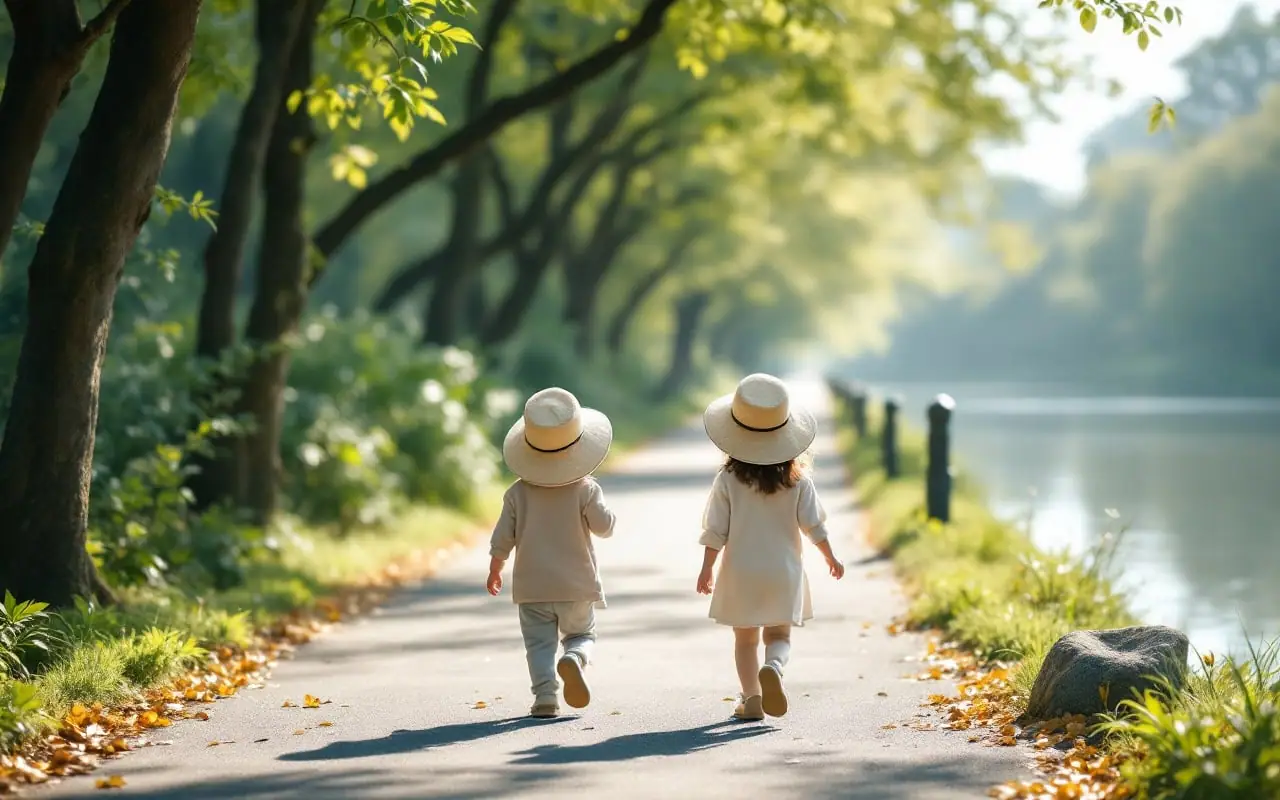
On a Kyoto afternoon in August, two straight hours outside is not realistic, and heatstroke is the more pressing danger. So in our family we add outdoor time in smaller pieces:
- A walk around the neighborhood or a stop at the park while the morning is still cool
- An evening stroll along the Kamo River once the sun drops and a breeze comes up
- Walking to the pool or to lessons when the distance allows
- Short outdoor jobs, like watering the morning glories or hunting for empty cicada shells
- Staying out a little later on special nights, such as 16 August, when the Gozan Okuribi bonfires are lit on the hills around the city
The time can be added up over the day. Even in the shade, daylight is far brighter than most rooms indoors.
Protect eyes from the sun as well as bodies from the heat. A hat with a proper brim and children's sunglasses labeled UV400 or 100% UVA/UVB both help, and a column on summer sun and the eyes goes into more detail. Drinks, shade and avoiding the hottest hours come first.
Four habits for close-up work
Summer homework means long sessions at the desk, with the focusing muscles working the whole time. Four habits help.
Keep it at least 30 cm away
About 30 cm (12 inches) between eyes and page or screen is the usual guide. That is the length of a standard school ruler, and holding one up once works better than saying "move back" ten times. Faces drift closer when children are absorbed, so a gentle reminder is enough.
Look up every 30 minutes
After about half an hour, have your child look at something far away, out of the window if possible. A kitchen timer helps, or a rule such as looking outside at the end of every workbook page.
Sit properly
Reading while lying on the stomach pulls the face close to the page, and a rounded back pushes the head forward. When your child sits back in the chair, both feet should rest flat on the floor. Children outgrow furniture fast, so check desk and chair heights each school year.
Light the whole room
A dark room with only the page or screen lit is tiring. Turn on the main light, then add a desk lamp: on the left for a right-handed child, on the right for a left-handed one, so the writing hand does not shadow the page.
School tablets and screens at home
In many countries, Japan included, schools now give every child a tablet or laptop, and summer homework often arrives on it. The device is not the enemy. What matters is how it is used and how long the day's total runs.
A tablet set on a desk and tilted slightly is easier to keep at a sensible distance; held in the hands, it creeps closer as arms tire. Teach children to zoom in on small text instead of leaning in. Phones and handheld game consoles tend to end up close to the face, so keep long sessions on them short.
Homework, videos and games together can come to more than you expect, so try writing out a typical day on paper. In my experience, screen rules that children help to set are followed far better than rules handed down. Agreeing on a time when devices go away for the night helps both sleep and eyes.
"Won't glasses make it worse?"
Talk with other parents long enough and someone will say they are holding off on glasses because glasses make myopia worse. Glasses that are correctly prescribed are not thought to make myopia progress.
Going without clear vision has real costs. A child who cannot read the board can fall behind, and squinting all day is tiring. Children often cannot put blurry vision into words, so they may never tell you.
Choosing a weaker prescription than needed is not a reliable way to slow myopia either. The right prescription, and whether glasses are worn all day or only for distance, depends on the child's eyes and should come from a proper eye exam. Prescriptions change as children grow, so regular follow-up checks are part of the plan.
Treatments that aim to slow myopia
Treatments designed to slow myopia in children have become more widely available in recent years. Depending on where you live, they include special eye drops, glasses with specially designed lenses, and specially designed contact lenses, some worn only overnight.
They differ in the ages they suit, how often you need to visit, and cost. Children respond differently, and none is a one-off: the eye doctor usually measures the eye at regular visits and reviews with you whether to continue.
Whether to start, and which option fits, is decided by your child's eye doctor after examining the eyes and talking it through with you. Please do not decide from something you read online or what another family chose. The same goes for gadgets or foods advertised as improving children's eyesight: ask your eye doctor.
Signs it is time for an eye exam
Only an eye exam can tell you whether a child is nearsighted, and by how much. Book one if you notice any of these:
- Sitting very close to the TV, holding screens close, or squinting
- Tilting the head or looking out of the corner of the eye
- Rubbing the eyes often or blinking a lot
- Saying the board at school is hard to read
- Closing one eye in bright light
- Headaches or tired eyes after reading
- A school screening letter recommending an eye exam
Try not to file a screening letter away for later. Going during the break means the new term starts with the question settled, though clinics can be busy in August, so check clinic hours and booking early. Eye checks through life gives an overview of checks at different ages.
In many countries an optometrist can test vision and prescribe glasses, while an ophthalmologist is a medical doctor who specializes in eyes and treats eye disease. An optician fits and supplies the glasses. If you are unsure where to start, ask your child's doctor or school nurse.
Expect more than a letter chart. The eye doctor will measure the prescription, look at the back of the eye, and may use the focus-relaxing drops mentioned earlier, which can leave eyes light-sensitive and close vision blurry for hours. Keep the rest of the day quiet, and bring any screening letters and past records. Your first eye exam explains more.
When not to wait
Have your child seen by an eye doctor the same day if:
- Vision suddenly becomes blurry, or your child starts seeing double
- Vision seems wrong after a knock to the eye, or the pain does not go away
- There is severe eye pain or a very red eye
- A chemical such as a cleaning product gets in the eye. Do not let your child rub it. Rinse right away with plenty of clean water for at least 15 minutes, then get urgent care. Alkalis such as oven cleaner, drain cleaner, lime and cement are especially dangerous.
If an injury looks serious, or anything seems life-threatening, call your local emergency number (such as 911, 999, 112, or 119 in Japan). The pages on eye emergencies and first aid and who to ask about an eye worry help when you are not sure where to turn.
Small changes, every summer
Add a little time outdoors. Agree on distance and breaks for close work as a family. Take any worries to an eye doctor. None of this is dramatic, but repeated summer after summer, these habits help look after eyes your child will rely on for a lifetime.