Kyoto & the Seasons · Everyday Eye Care
Summer sun and your eyes: hats, sunglasses and UV in festival season
On Yoiyama, the eve of the Gion Matsuri float procession, the streets around Shijo and Muromachi fill with the glow of paper lanterns and the clatter of festival music. Tomorrow the great floats roll through the city. Walking streets that hold the day's heat long after dark, I feel that the Kyoto summer has properly arrived.
Daytime is another matter. Along the procession route, and in the side streets where the floats are assembled, people stand for hours under a hard sun. Most of them think about water and sweat; far fewer think about their eyes. Summer sunlight carries plenty of ultraviolet (UV) radiation, and it affects the eyes as well as the skin.
Light from above, and from below
Kyoto lies in a basin, and in summer the air barely moves. Walking a sunlit street, you feel heat rising from the pavement as much as falling from the sky. UV behaves in a similar way. It reaches us directly from the sun, scattered across the sky, and reflected off the ground and water, so it can enter the eyes from the side and from below. On a riverbank, in a temple courtyard of pale gravel, or beside water flashing in the sun, a hat brim alone will not block all of it.
Summer here is also a season for water: dining platforms along the Kamo River, decks above the stream at Kibune, trips north to the coast. The cooler a spot feels, the easier it is to forget the light bouncing off the water.
UV is generally strongest from spring through summer and around the middle of the day. A good deal still passes through thin cloud, so a hazy day is not a safe day.
Two ways UV harms the eyes
Some UV damage shows up within hours. Some builds over many years.
The quick kind is photokeratitis, a sunburn of the cornea, the clear front surface of the eye. It is best known as snow blindness, which is why people think of it as a winter problem, but the same thing can happen on a beach, on the water or in the mountains in July. Welder's flash, caused by the light of a welding arc, is the same kind of injury. Symptoms often appear several hours after exposure, so sudden pain in the evening can come as a surprise.
See an eye doctor if you notice:
- strong pain, or a gritty feeling as if there were sand in the eye
- tears that will not stop
- red eyes
- light that feels painfully bright, so you can barely keep your eyes open
Do not rub, and do not keep adding whatever drops happen to be in the cupboard. If the pain is severe or your vision is blurred, get seen the same day, through an urgent or after-hours service if your usual clinic is closed.
The slow kind adds up over a lifetime. Years of UV exposure have been linked to cataract and to pterygium, a wedge of tissue that grows from the white of the eye onto the cornea and can affect vision if it spreads far enough. A pinguecula, a small yellowish bump on the white of the eye, is also associated with sun exposure. Cataract comes to everyone with age, but UV is counted among the factors that can contribute. None of these appears after one summer, but exposure accumulates, so it pays to protect your eyes from a young age. Common eye conditions describes each in more detail.
What to look for in sunglasses
Sunglasses are the obvious protection, but sunglasses chosen for style and sunglasses chosen for your eyes are judged differently. Check:
- the UV label: look for "UV400" or "100% UVA/UVB" on the tag or leaflet
- more than the darkness of the lens
- size and shape, with lenses that are not too small and that follow the curve of your face, leaving little gap at the sides, top and bottom
- fit at the nose and ears, so they stay put when you move
- that they suit how you will use them, for driving or for a day by the water
Darkness is the one people miss. For years I chose sunglasses on looks and assumed the darker the lens, the better it protected me. Darkness and UV protection are separate things. Behind a dark lens your pupils widen to let in more light, and if that lens does not block UV properly, it may let more UV into the eye than wearing no sunglasses at all. A lightly tinted lens can block UV fully. Read the label, not the color.
Fit matters for the same reason. UV comes in from the sides and below, so small lenses or a big gap around the frame let it in. When trying a pair on, turn your head and look down as well as facing the mirror, and check that light does not slip in around the edges.
People who spend time near water often like polarized lenses, which cut glare from the surface. Glare reduction and UV protection are different jobs, so check the label here too. Very dark lenses are not suitable for driving, especially through tunnels or as the light fades. If you wear glasses, prescription sunglasses or frames that fit over your own are both options. Lenses that darken in sunlight are convenient, but they darken less inside a car because the windshield blocks most UV.
An optician, who fits and supplies glasses, can help match lenses to how you live. An optometrist examines eyes and prescribes lenses, and an ophthalmologist is a medical doctor who treats eye disease.
One Kyoto habit worth passing on: a day of temples means stepping from a blazing courtyard into a dim hall, and with sunglasses on, steps and raised thresholds can vanish. I take mine off before going inside.
Hats, parasols and the shady side of the street
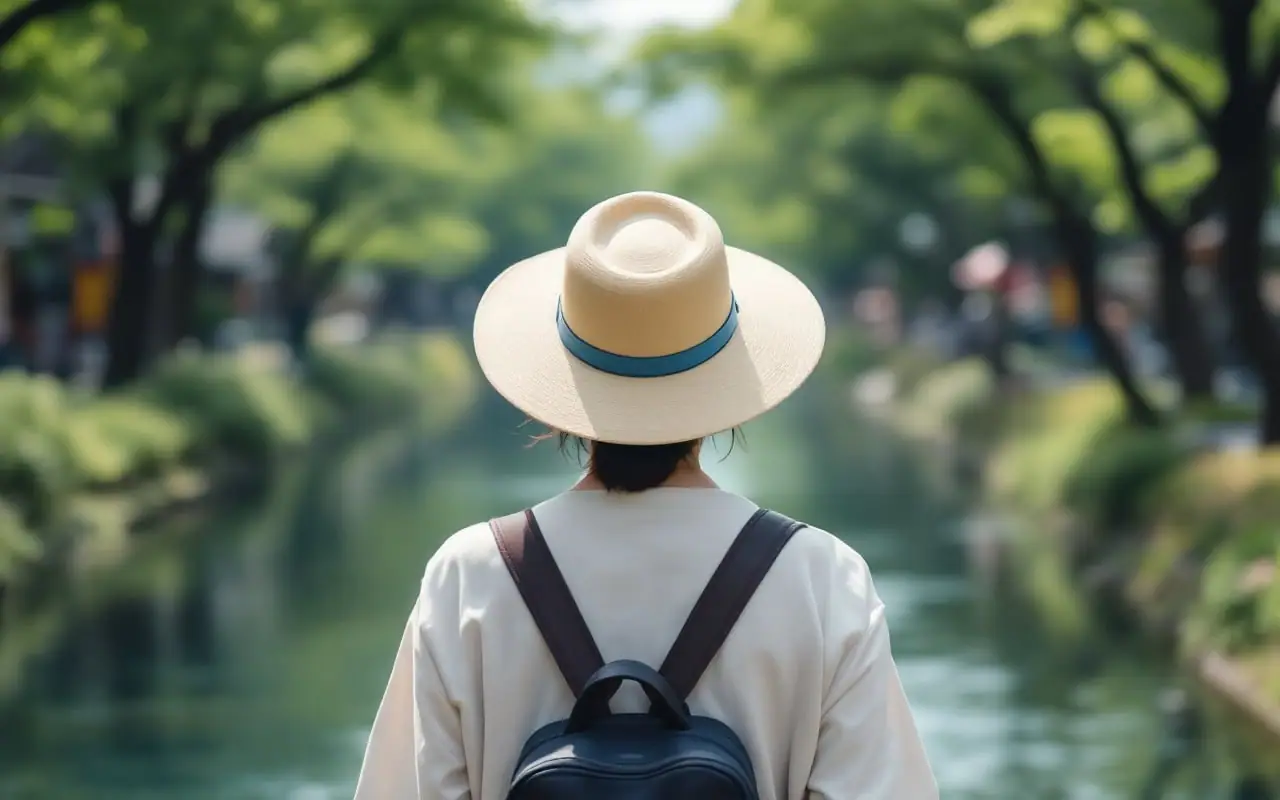
Sunglasses rarely do the whole job alone. A wide-brimmed hat cuts much of the light reaching the eyes from above, and together with sunglasses it covers you from above and the sides. A brim all the way round blocks more side light than a cap with a peak at the front, and on a windy riverbank a chin strap saves chasing your hat down the bank.
Parasols are an ordinary sight on Kyoto's summer streets, and the shade they cast helps the eyes too. Your route matters as well. Kyoto's streets run in a grid, and which side is shaded changes through the day; keeping to the shady side noticeably cuts the light reaching your eyes.
Some typical summer situations and what to watch:
| Situation | What to watch |
|---|---|
| Waiting for a parade or festival procession | A wide-brimmed hat with sunglasses; find shade wherever you can |
| A riverside walk or an evening by the water | Glare off the water and light from the side; keep the hat on until the sun is low |
| A day at the beach, a lake or an outdoor pool | Reflection from sand and water; the longer the day, the more it adds up |
| Cycling | Sunglasses that stay put in the wind, but not so dark that curbs and signals disappear |
| After sunset | Take dark lenses off; poor vision in dim light leads to falls and accidents |
Children in the summer sun
The lens inside a child's eye is clearer than an adult's, so more UV reaches the back of the eye. Summer holidays mean long hours outdoors, which makes a hat worth turning into a habit. Babies in strollers cannot turn away from the sun, so use a canopy and choose shady paths. If a child complains of eye pain after a day out, or squints and struggles to open their eyes, see an eye doctor promptly.
Do not cut back outdoor play itself. Studies suggest that around two hours a day outdoors helps reduce the chance of children becoming nearsighted. Seek shade at midday, wear a hat, take breaks, and let them enjoy the summer.
If your child wears sunglasses, check the UV label as you would for your own; some toy sunglasses have none, and a tinted lens that lets UV through can do more harm than good. Summer break is also a good time to catch up on a vision check that has slipped, and the column on vision screening for young children explains why those checks matter.
Pool water can leave eyes red, and goggles help. Contagious eye infections also spread more in summer, including one viral illness, sometimes called pool fever, that brings fever and a sore throat along with red eyes. If a child has red eyes with a fever or sore throat, more discharge than usual, or one eye much redder than the other, see a doctor soon and keep towels separate. The spring column on itchy eyes in allergy season explains how infection differs from allergy.
Contact lenses cover only part of the eye
Some contact lenses absorb UV, but a lens covers only the cornea and a little around it. It does nothing for the white of the eye, the eyelids or the skin around them, so wear a hat and sunglasses on long days outside even with UV-blocking lenses.
Summer brings its own lens problems. Sweat and sunscreen can sting and film the lenses. Swimming in lenses risks losing them, and water exposure is linked to Acanthamoeba keratitis, a rare but serious eye infection. Take lenses out before the pool, river or sea and wear glasses, or prescription goggles if you need to see in the water. Never rinse lenses or the case with tap water.
Some people wear colored lenses only for festivals or trips. Even with no prescription, they are medical devices and need a proper fitting by an eye care professional. Never share them, and keep to the wearing schedule.
If you wear lenses and develop pain, redness, sensitivity to light or blurred vision, take them out and see an eye doctor the same day.
Obon and the bonfires
In August the city turns toward Obon, when families honor their ancestors. On the night of August 16 the Gozan Okuribi bonfires burn on the hills around the city, the evening heat eases a little, and summer begins to feel finite. Other dates for the eyes through the year are in the eye health calendar.
Obon is when many people travel or go home to family, and your usual clinic may be closed. Eye trouble on holidays and long weekends explains how to find care. New flashes of light, a sudden shower of floaters or a shadow spreading over part of your vision need same-day eye care. Sudden loss of vision in one eye, even if it returns, or severe eye pain with blurred vision, is an emergency: go to emergency care or call your local emergency number (such as 911, 999, 112, or 119 in Japan). Eye emergencies and first aid lists what to do.
Time with family can reveal changes you would miss on the phone: a parent squinting in bright light, struggling with the newspaper, catching a foot on a step. If you notice something like this, skip the lecture and simply suggest an eye check.
A Kyoto summer is full of things to enjoy, the heat included. Put a hat and a pair of sunglasses in the bag you carry every day. And if pain or sensitivity to light lingers after a day in the sun, see an eye doctor.