Vision screening for young children: catching amblyopia while there is time
In Japan, a few weeks before a child's three-year health check, a thick envelope arrives from the local council. Tucked among the questionnaires is a sheet asking parents to test their child's eyesight at home. When ours came, my first thought was that a three-year-old surely could not do an eye test. To be honest, I nearly put that page aside.
Many countries offer something similar: a vision check for young children somewhere between about three and five, at a health visit, a nursery or preschool, or when school begins. The details differ, but the purpose is the same everywhere. It is a chance to find amblyopia, often called lazy eye, early enough to treat it well. As a parent who has been through it, here is what the check is for, how to help your child with it, and what to do once the result arrives.
Amblyopia is not just "weak eyes"
You might assume amblyopia simply means poor eyesight. It is more specific than that.
Newborn babies see mostly blur. Vision develops as the eyes and brain get daily practice at seeing things clearly. If something blocks that clear image in early childhood, vision in one or both eyes does not develop fully. That is amblyopia. One of its features is that glasses do not make the eye see well straight away; the vision itself needs time and treatment to catch up.
Things that can block a clear image include:
- strong farsightedness or astigmatism, so nothing is quite in focus
- a big difference in prescription between the two eyes, so the child leans on the better one
- a squint (strabismus), where one eye turns in, out, up or down and the brain stops using it
- something physically in the way, such as a drooping eyelid over the pupil or a cataract present from birth
A squint can look like a matter of appearance, but the two eyes working together is also how children learn to judge depth. If an eye seems to wander, have it checked along with any vision test.
Amblyopia affects about 2 to 3 of every 100 children. It is not rare.
A window that does not stay open
Vision develops most in early childhood, until about age 7 or 8. Finding the cause during these years and starting treatment, often simply glasses, gives vision the best chance to develop. If amblyopia is found later, treatment tends to be harder and less effective.
That is why screening is timed as it is. By three or four, most children can manage a simple test, and there are still years left in which treatment works well.
The hard part is that children with amblyopia almost never say they cannot see. They have always seen this way and assume it is normal. When only one eye is affected, the other does all the work, and even the family who spend every day with the child are unlikely to notice. A little one who runs about happily and pores over picture books can still have amblyopia.
Helping your child with the vision test
Screening tests use pictures, letters or shapes suited to young children. A common one, and the one in Japan's home test, is the Landolt C: a ring with a gap like the letter C, where the child shows which way the gap faces. Others use a tumbling E or picture-matching cards. Follow the instructions you are given on distance and recording, and look through any practice cards first.
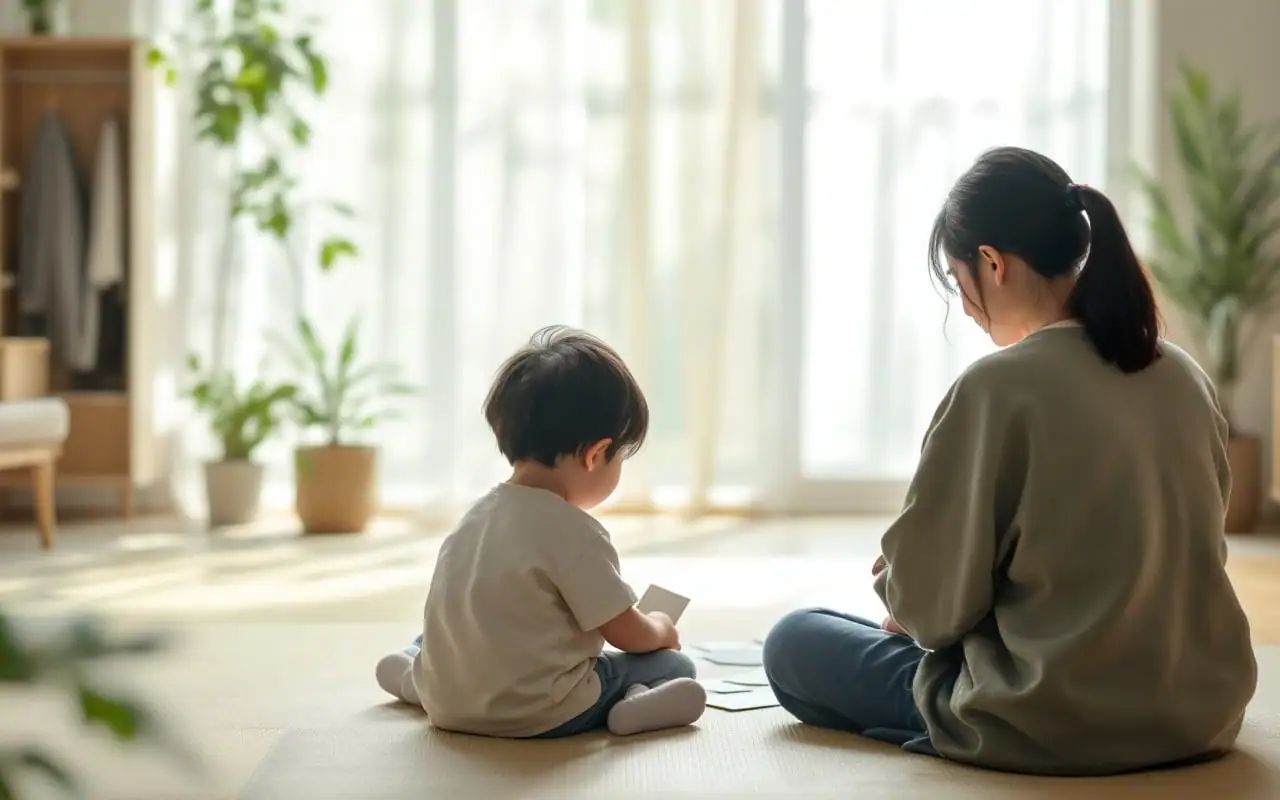
Asked which side is open, most three-year-olds have no idea what you want at first. Jumping straight into the real test rarely works, and practicing close up makes a big difference. These things helped in our house:
- turning the ring into a doughnut, or a mouth: "Which way is the mouth open?"
- letting the child answer however is easiest, by pointing, picking a card facing the same way, or making the shape with a hand
- once they have the idea, stepping back bit by bit toward the distance in the instructions
- avoiding sleepy or hungry times, and stopping while it is still fun
- using a bright room with no shadows on the chart
The heart of the test is checking one eye at a time. Cover one eye gently with a palm or a folded tissue. Children love to peek between fingers or press on the covered eye, and if the cover slips you end up testing both eyes together, so watch from the side. If your child really will not have an eye covered, do not hold them down. Try another day.
Try not to lead. Ask "Is it at the top?" and a small child will often just agree. React the same way to right and wrong answers, and praise effort: "You looked really carefully."
The thing I most want to say is this: write down what actually happened, even if it went badly. If one eye seemed harder, or your child refused every time, that is useful information about how they see. Marking it as a pass because they can probably see fine defeats the purpose of the test. Record what you saw and add a note in the margin if something bothered you.
Screening with a camera-like device
Some programs also use an instrument screener, as a growing number of local three-year checks in Japan now do. The child looks toward a device held a short distance away, a little like having a photo taken, and it measures how the eyes focus. Nothing touches the eye and it takes moments, so even small children usually cope well.
A vision chart depends on the child answering, and young children's answers are not always clear. An instrument screener helps fill that gap by picking up strong farsightedness, astigmatism and large differences between the eyes, common causes of amblyopia. It has limits too, and works best alongside the vision test, a questionnaire and a check of how the eyes line up.
What is offered, at what age and by whom varies a great deal between countries and even between towns. Ask your child's doctor, health visitor, nursery or school nurse what is available where you live. If you have noticed anything, such as an eye that sometimes drifts or a child who sits very close to the TV, mention it at the check.
If the result says "refer"
Sometimes the result comes back as "refer" or "please see an eye doctor". It is a jolt, but it is not a diagnosis. Screening is designed to pick out children who need a closer look, and some of them turn out to be fine.
What matters is not leaving it. Book an eye doctor soon, ideally one used to small children. Pediatric ophthalmologists specialize in children's eyes, and orthoptists, who assess eye alignment and how the two eyes work together, are often part of the team. If you are not sure where to go, the people who ran the screening can usually point you in the right direction.
Bring the result slip or referral letter and your child's health records. The eye doctor may use drops that relax the eye's focusing so the prescription can be measured accurately. They take a while to work, and blurred vision and sensitivity to light can last for some hours afterward, so leave plenty of time and keep the rest of the day light.
If glasses are prescribed, some parents feel sorry to see such a small child wearing them. In amblyopia treatment, though, glasses are often the main tool: they give the brain a clear image to learn from. Some children also need the stronger eye covered with a patch for part of the day. What treatment is needed, and for how long, is for the eye doctor to decide after examining your child, and the clinic team can show you how to manage it at home.
Signs you might notice at home
Between checks, everyday behavior can hint at a vision problem. If any of these keep happening, see an eye doctor without waiting for the next screening:
- holding books very close, or sitting right up against the TV
- squinting to look at things
- tilting the head or turning the face to one side to look
- closing one eye even when it is not bright
- an eye that seems to turn in or out
- getting very upset when one eye is covered and pushing your hand away
- bumping into things or tripping often
The last two can happen when one eye, or both, sees poorly. A child who hates having one eye covered may be relying on that eye. Some families first spot a squint in photos, where one eye points slightly differently from the other.
Some things should not wait. See an eye doctor the same day, or go to emergency care, if:
- in flash photos one pupil glows white or looks different from the other, or a pupil looks white in ordinary light
- your child has been hit in the eye, has something in it, or is in pain and cannot be settled
- a chemical such as a cleaning product gets in the eye: stop them rubbing, rinse at once with plenty of clean water for at least 15 minutes, then get urgent care (alkalis such as oven or drain cleaner are especially dangerous)
If your child is badly hurt or very unwell, call your local emergency number (such as 911, 999, 112, or 119 in Japan). Eye emergencies and first aid covers what to do in more detail.
Questions parents often ask
Isn't three too young for a vision test?
First attempts often go badly. Spread practice over a few days and most children catch on. If yours still cannot do it, write that down and bring it along; not managing the test can itself be a reason to look more closely.
My child passed. Can I stop thinking about it?
Screening is very useful, but it does not catch everything. If any of the signs above appear later, see an eye doctor without waiting for the next check. Schools often test vision too, so read those results each time.
My child pulls their glasses off straight away.
Few small children accept glasses at once. Frames that do not fit, or a prescription that needs adjusting, can make them uncomfortable, so ask the eye doctor or the shop that made them. Starting with favorite activities, and plenty of praise when the glasses stay on, helps many children get used to them.
The older one was fine. Will the younger one be too?
Brothers and sisters can have very different eyes, so give each child's test the same care. If anyone in the family has had amblyopia or a squint and you are worried, you do not need to wait for screening to ask an eye doctor.
I don't know who to ask.
Your child's pediatrician or family doctor, or whoever runs local screening, is a good first call. Who to ask about an eye worry has more ideas.
After the screening
An early vision check is the first milestone, not the last. Children's eyes are checked again as they grow, and eye checks through life lists the usual checks at each age.
Children almost never tell you they cannot see well. So do the test carefully, write down what really happened, and ask an eye doctor whenever something seems not quite right. Each of those small steps helps a child's sight grow. When in doubt, ask.