Kyoto & the Seasons · Everyday Eye Care
A day among the autumn leaves: glare, dry wind and steps at dusk
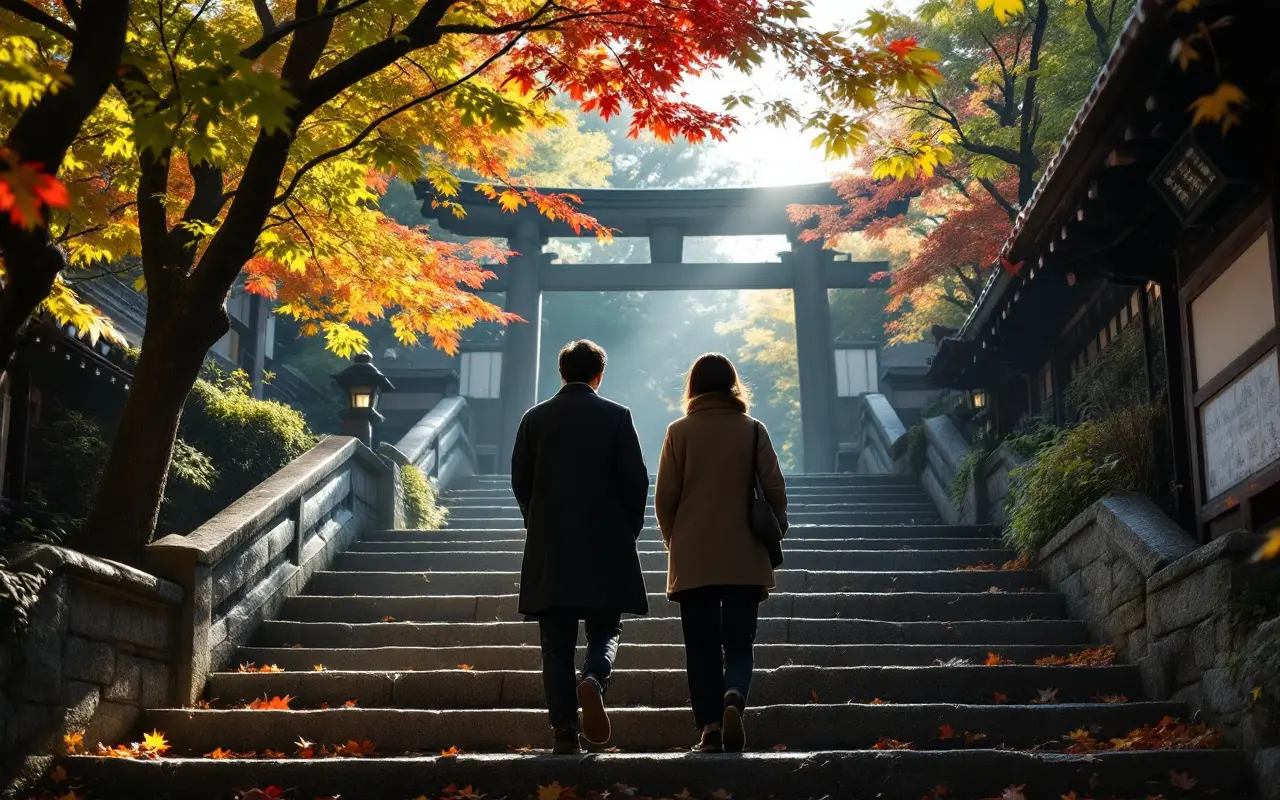
In November the hills around Kyoto change color from the top down. As the mornings grow colder, the maples in town start to redden too, and people spread out maps to plan which temples to visit, and in what order.
Leaf viewing is usually a whole day on foot. People come home with red, tired eyes, or remember a moment on a temple path at dusk when they could barely see their own feet. A day with the leaves is also, for your eyes, a day of low sun, dry wind and early darkness. That holds for an autumn walk anywhere, from a mountain trail to a city park. A little preparation goes a long way.
Autumn sun comes in low and from the side
From autumn into winter the sun travels lower across the sky and its light arrives at a slant. Compared with the high summer sun, a hat brim does less to block it, and it shines more directly into your eyes. Walk west in the afternoon and the sun can sit right at eye level, so bright that the person ahead of you turns into a silhouette.
The leaves add their own glare. Backlit red and yellow leaves are beautiful, but gazing up at them against a bright sky for long stretches tires the eyes. Ponds, and the raked white gravel of temple gardens, reflect the light on clear days. At a lookout at sunset, the sinking sun tends to end up in the middle of your photo. However lovely the view, don't look straight at the sun, even briefly.
There is less ultraviolet light in autumn than in summer, but on a clear day spent outdoors the exposure still adds up. Here is a rough guide to the light through the day.
| Time of day | What the light is like | What to watch for |
|---|---|---|
| Morning | Low sun from the east; cold, clear air can make glare feel stronger | Pull your hat brim lower when walking east; cyclists, watch the road ahead |
| Around midday | The sun is at its highest, though lower than in summer | Long spells of looking up tire the eyes; rest them in the shade now and then |
| Afternoon | The sun sinks in the west toward eye level | On west-facing roads, glare makes it easier to miss traffic lights and people |
| Dusk | Once the sun drops behind the hills, temple grounds and lanes go dark quickly | Take off dark sunglasses; watch steps and uneven ground |
If you drive to see the leaves, watch for dappled light on wooded roads. Bright sun and deep shade alternate every few seconds, your eyes can't keep up, and it is easy to miss a walker or cyclist around the next bend. Lower the sun visor early, slow down a little, and keep driving sunglasses light enough for the shady stretches.
Hats and sunglasses still earn their place
The summer column on UV, hats and sunglasses covers the basics: choose sunglasses by their labeling, such as "UV400" or "100% UVA/UVB," rather than by how dark the lenses look, and pick a shape that blocks light from the sides. None of that changes in autumn. The way you use them does.
Start with the hat. Low sun slips in under the brim, so wear a brimmed hat a little lower over your eyes and it will block much of the light from the front. On windy days, a chin strap or a snug fit keeps it from blowing away.
Sunglasses that follow the curve of your face, with little gap at the sides, also keep out light from the side and below. Tinted lenses can change how the leaves look, and when the colors seem wrong it is tempting to take the glasses off altogether. If you want the view as it is, ask an optician about lenses that keep colors natural. If you wear prescription glasses, there are prescription sunglasses and styles that fit over your regular pair.
Look out for your companions, too. Children pull their hats off, and older relatives concentrating on their footing may simply put up with the glare. A quick question at each rest stop can be the cue to move into the shade.
Plan for going indoors, too. Temple halls are much darker than the gardens outside, and sunglasses make steps and raised thresholds hard to see in there. Take them off at the entrance, and if you wear glasses, switch back to your regular pair. It takes a few seconds and can save a stumble.
Dry wind and contact lenses
Autumn air is dry, and at mountain temples or along a river the wind can be surprisingly strong. Hours in a cold wind evaporate the tears, and the eyes start to feel sore and gritty. A hat brim and glasses double as windbreaks. If your eyes dry out easily, the habits in the column on dry eye and screen time help on days out as well.
Contact lens wearers may feel the lens sticking in dry wind, or get a fragment of leaf or a speck of dust trapped beneath it. When that happens, don't rub. Clean your hands, take the lens out, and don't rinse it with tap water.
For a full day outside, these are worth carrying:
- your regular glasses
- spare lenses, a lens case and solution
- a clean handkerchief or wet wipes for your hands
If you carry eye drops, ask a pharmacist when you buy them whether they can be used with contact lenses in. Wipe your hands before putting drops in outdoors, keep the tip of the bottle away from lashes and lids, and close your eyes for a moment afterward. Autumn is also ragweed pollen season in many places, and itching can join the dryness.
Heated trains and buses dry the eyes too. On the ride, rest them or look out at the distant hills instead of at your phone.
Unexpected eye injuries in crowds
On a peak-season weekend the famous leaf spots get very crowded, and things you would never normally notice end up close to your face.
Umbrellas are one. On a rainy day, or when a sun umbrella is folded and carried, the tip can point backward at the face of the person behind. Small children's faces are at exactly the height of an adult's hands. On stairs and busy paths, carry a folded umbrella pointing down, close to your body.
Branches are another. Leaning in for a close look at the leaves, or ducking under a bough for a photo, a twig can catch you in the eye. Some garden paths have low branches at eye height. When taking photos, look around you as well as at the screen.
With your eyes on the canopy you miss steps, tree roots and the person in front stopping. Stop to look up, and look ahead when you walk; that one habit helps prevent both eye injuries and falls.
If a branch or umbrella hits your eye, don't rub it. Cover one eye at a time and check how well each eye sees. Strong pain, blurred vision, sensitivity to light, tears that won't stop or double vision mean seeing an eye doctor the same day. A scratch from plant material can become infected later, so even if it seems minor at first, get it checked if pain or redness is still there the next day.
If a child is crying and holding an eye, calm them first and gently keep their hands away from it. Don't force a painful lid open to look inside. If the child can't open the eye or keeps it squeezed shut, take them to an eye doctor that day. For grit and other foreign bodies, see the page on eye emergencies and first aid.
Stone steps at dusk and dark temple grounds
On autumn evenings it gets dark fast once the sun drops behind the hills. Eyes take time to adjust when you move from bright to dark: from a sunlit approach into wooded grounds, or from a lamplit hall onto steps that have gone dim. For a while you may hardly see your feet.
On stone steps the edges blur into the shadows, and damp moss and fallen leaves are slippery, especially on the way down. At temples that light up their trees in the evening, as many in Kyoto do in the leaf season, the contrast between floodlit and unlit areas is strong, and after gazing at bright trees the ground looks darker still.
With age, many people find it harder to see in dim light and are more bothered by glare. A cataract can make lights look smeared or dazzling and dark places harder to see in. If step edges have become harder to judge in the evening, or oncoming headlights have started to feel painfully bright, mention it to an eye doctor. The column on when to consider cataract surgery explains how cataracts change vision.
To keep your footing at dusk:
- While it is still light, check the route back and where the steps are.
- Use handrails, and carry your bag on your shoulder so both hands are free.
- If you wear progressive lenses, tilt your whole head down on steps, not just your eyes.
- If you use a light for your feet, keep it pointed away from other people's faces.
Cyclists should check their lights before dusk, when bikes are hardest to see. Start back a little before the crowds and the darkness, and the walk home will be easier on your eyes and your legs.
Back home, and when to see an eye doctor
At home, wash your hands, take out your lenses and rest your eyes closed for a while. Tired or mildly dry eyes after a day outdoors usually recover overnight. Your photos can wait until tomorrow.
If redness or grittiness is still there the next morning, leave your lenses out for a day and wear glasses. If there is no improvement, or things get worse, see an eye doctor.
See an eye doctor promptly, without waiting to see how it goes, if:
- pain, blurring, light sensitivity or watering continue after a branch or umbrella hit your eye,
- it still feels as if something is in your eye,
- strong pain or redness remains after you remove your contact lenses,
- redness or discharge gets worse day by day.
Get emergency care straight away, even at night, for sudden severe eye pain with blurred vision, headache or nausea, or if you suddenly lose vision in one eye. For anything that seems life-threatening, call your local emergency number (such as 911, 999, 112, or 119 in Japan).
Over the weeks of autumn, the best color works its way down from the mountaintops into the city. Pack a hat, your glasses and spare lenses, take the steps one at a time as the light fades, and enjoy the walk.