Evening light at home and your eyes: what to change room by room, and when to get them checked
In December the light goes early in Kyoto. By five o'clock the street outside my window is dark, and the evening I spend at home is lit entirely by the lamps I chose years ago without much thought. One winter I caught myself carrying a small desk lamp from room to room. From changing a single bulb to indoor lighting installation Colorado Springs CO homeowners plan for a whole house, the question is the same everywhere: does the light fall where your eyes need it?
This column follows one evening at home, room by room, and looks at what your eyes meet in each: how much light, where it comes from, how much glare. At the end there is a note on the changes in vision that are worth an eye doctor's attention rather than a brighter bulb.
Three words that make lighting easier to talk about
Before walking through the rooms, it helps to have a few terms, explained plainly.
- Brightness is simply how much light reaches what you are looking at. A room can have a bright ceiling lamp and still leave the page in your hands in shadow.
- Glare is light that reaches the eye from a bright source or a shiny surface and makes it harder to see detail. A bare bulb in your line of sight or a lamp reflecting off a glossy table both cause it.
- Color temperature describes whether light looks warm and yellowish or cool and bluish. Warm light feels relaxed in the evening; cooler, whiter light can make fine detail easier to pick out on a work surface.
What is generally understood is that the eye needs more light for close work as the years go by, and that it also becomes more sensitive to glare. Those two facts pull in different directions, which is why simply adding brighter bulbs often does not help. What helps is light that is placed well.
The kitchen counter: light in front of you, not behind
The kitchen is usually the first room of the evening. In many homes the only light is a ceiling fixture in the middle of the room. Stand at the counter and your own head and shoulders cast a shadow on the cutting board, just where your hands and the knife are.
It is one of the most common lighting problems in any home, and it has a simple principle behind it: task light should come from in front of you or from above the work surface, not from behind you. Light mounted under the upper cabinets, or a fixture directly over the counter, puts the light on the board instead of on your back.
The counter surface matters too. A polished stone or glossy tile counter can reflect a strong light straight back at you. A light that is shielded, so you see the lit surface rather than the bulb itself, cuts that glare a great deal.
The reading chair: one good lamp beats three weak ones
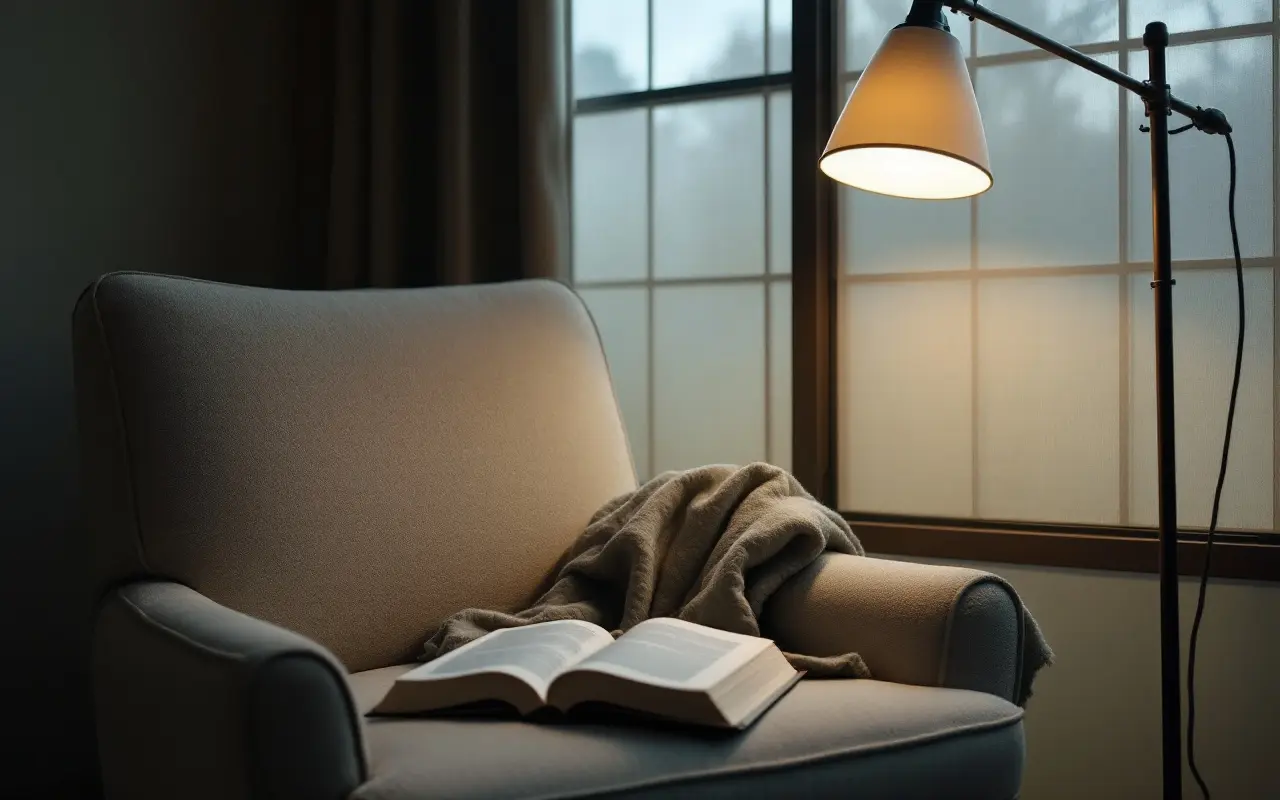
After dinner I read, and for years I read under a ceiling light and a small decorative lamp across the room. Neither put enough light on the page, and I would find myself holding the book closer and closer.
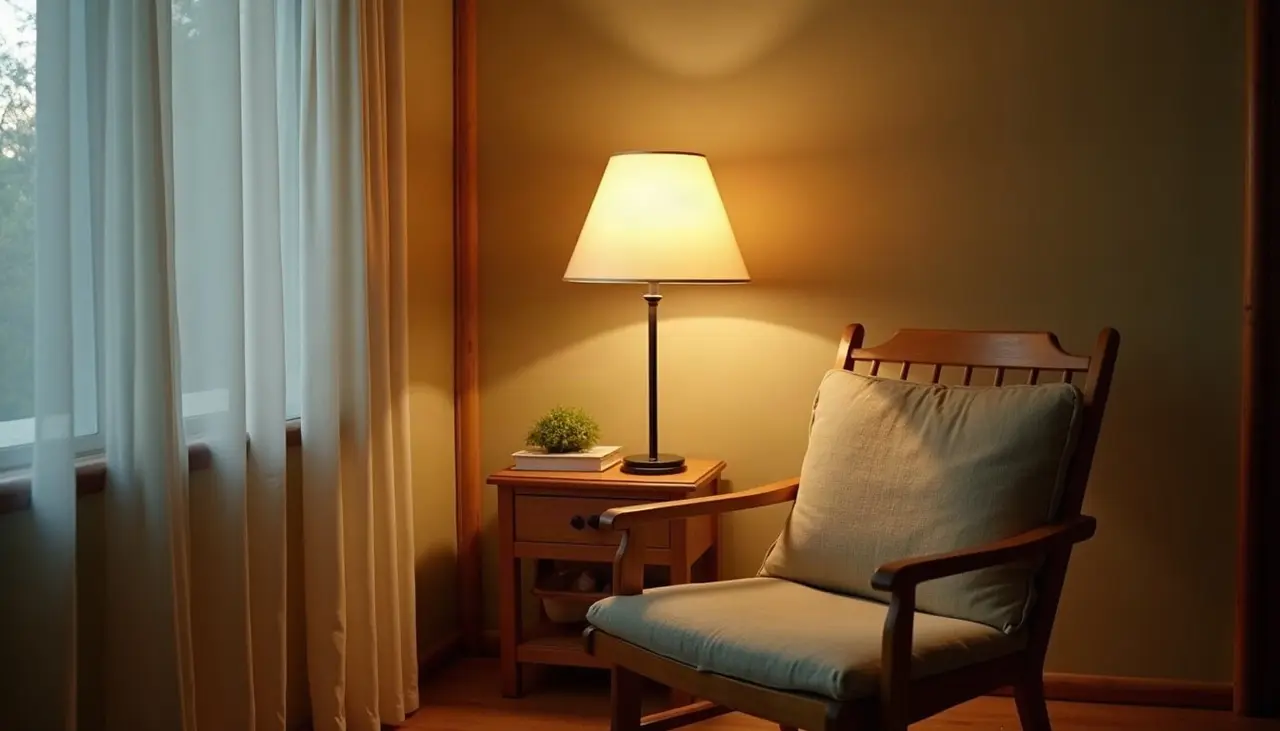
A reading lamp works well when it sits slightly behind and to the side of the chair, on the side opposite your writing hand if you also write notes, with the shade low enough that you never see the bulb from where you sit. Here is the short check I now use for any reading corner:
- Sit in the chair as you usually do, with the book where you usually hold it.
- Look up from the page. If you can see a bare bulb or a bright spot, the lamp is glaring.
- Look at the page. If your own hand or head shades it, move the lamp further to the side.
- Read for a few minutes. If you are drawing the book closer, the light on the page is too weak.
The rest of the room should not be dark. Reading in a pool of light surrounded by darkness makes the eyes keep adjusting each time you look up. A soft background light, even a dim one, makes the evening easier on the eyes.
My own lamp used to carry me through all of this: to the kitchen counter to read a recipe, to the hallway to find my keys, to the bedside for a last chapter. Each trip was a small sign that the room itself was not lit for what I did in it. If you notice the same habit in yourself, or in a parent who lives alone, treat it as a list of places that need their own light.
The hallway and stairs: even light and no dark patches
Later in the evening, the trip from the living room to the bedroom passes through the hallway and, in many homes, up a staircase. This is where lighting stops being a matter of comfort and becomes a matter of safety, particularly for older family members.
Eyes take time to adjust when moving from a bright room to a dim one. A staircase lit by one fixture at the top often leaves the lower steps in shadow, and the edges of the steps blend together. Light that reaches every step evenly, switches that can be reached at both the top and bottom, and low lights along the route to the bathroom at night are the changes that tend to make the biggest difference.
None of this is work for a reader to attempt alone. Adding fixtures, switches or new circuits involves wiring, and wiring belongs to a licensed electrician. What you can do is walk the route yourself in the evening and make a list of the dark patches before you talk to one.
What to note on your evening walk
- Spots where you reach for a wall or a rail because you cannot see the floor
- Switches you have to find in the dark
- Any bulb you can see directly from the stairs
- The path from the bedroom to the bathroom, with the main lights off
When to see an eye doctor
Better lighting makes daily life more comfortable, but it does not treat anything, and it can hide changes that need attention. If you find yourself adding more and more light to see well, it is worth having your eyes checked. See an eye doctor, an optometrist or an ophthalmologist depending on where you live, if you notice:
- blur that is new or getting worse, at near or at distance
- haloes or starbursts around lights, especially at night
- glare from lamps or headlights that bothers you more than it used to
- trouble seeing in dim light or adjusting from bright rooms to dark ones
- straight lines that look wavy, or a patch of vision that seems missing
- any sudden change in sight, which needs prompt care
These signs have many possible causes, some simple and some not, and only an examination can sort them out. I am a health writer, not a doctor. Decisions about your eyes belong to you and your eye doctor.
Almanac entry Season: early winter, when evenings are long and every room relies on lamps. What your eyes notice: shadows on the counter and a page that seems harder to read than last year. One thing to do: walk your evening route with the main lights off, and write down every dark patch.
Before the evenings grow longer
I no longer carry that desk lamp from room to room. The kitchen counter has its own light now, the reading chair has a lamp in the right place, and the hallway is no longer a dark gap between rooms. It took a careful look at one ordinary evening, not a new house. If the light still never seems enough, though, the problem may not be the lamps at all, and an early visit to an eye doctor is the sensible next step.