Autumn reading and tired eyes: lamps, print size and pauses
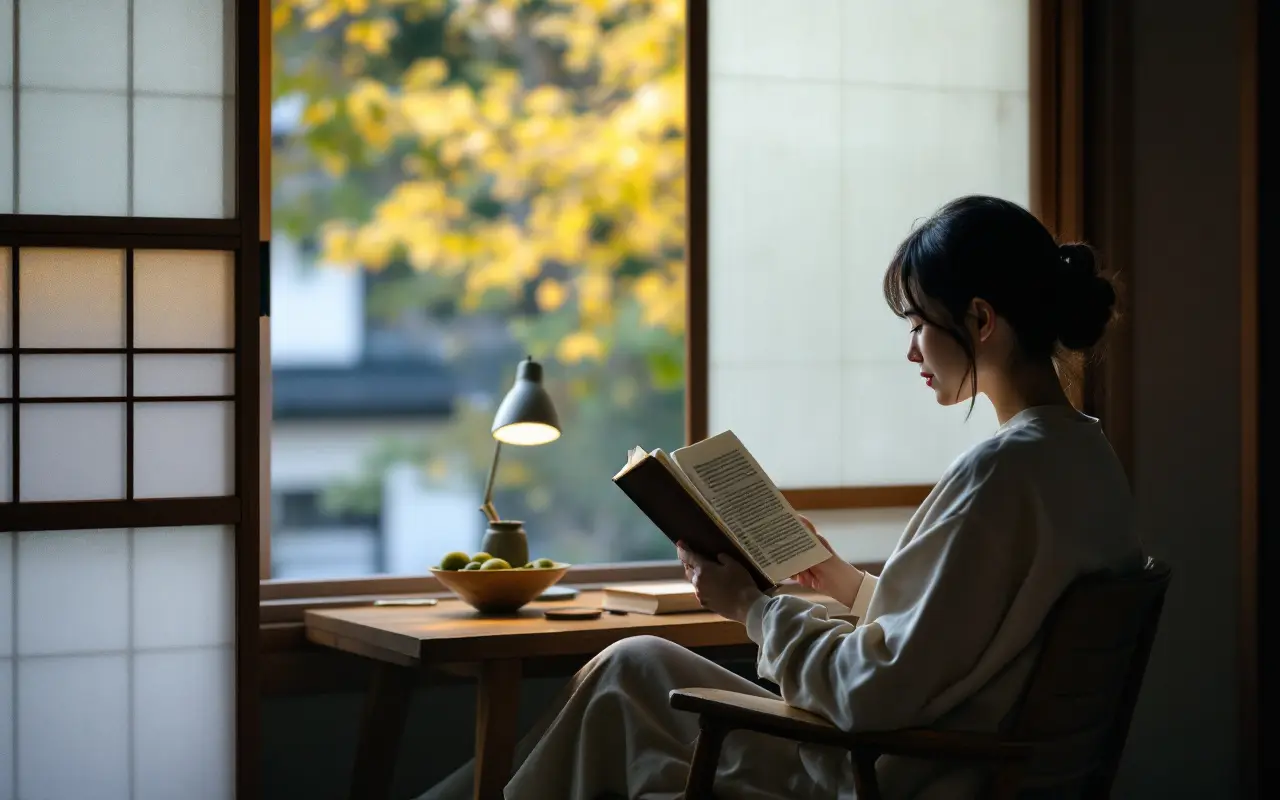
When the evenings start drawing in, a lot of people seem to rediscover reading. In Kyoto the air turns cool by late October, the windows stay shut after dark, and a lamp and a book feel like the natural way to end the day. Japan even sets aside about two weeks around Culture Day in early November as a national reading week.
Then, half an hour in, the eyes begin to feel heavy. The letters soften at the edges, and a stiffness creeps from behind the eyes into the neck and shoulders. The book itself is rarely the problem. Reading strain tends to build from small things around it: the light, how close the page is, how big the print is, and how long you go without looking up. All of them are easy to change.
Think of light in two layers: the room and the page
Most of us think of reading light as a matter of making the page bright. Comfort depends just as much on the difference in brightness between the page and everything around it.
Switch off the ceiling light and read by a single lamp, and the page glows white in a dark room. Every time your gaze drifts off the page and back, your eyes have to readjust to a very different level of light, and over an evening that seems to add to the tiredness. The usual advice is simple: keep the room lit, then add a lamp for the page.
Where to put the lamp
Place the lamp so the bulb or glowing panel is out of your direct line of sight. If you write as well as read, light from the side opposite your writing hand keeps your hand's shadow off the page. For reading alone, shift around until your head and shoulders stop throwing a shadow across the lines. Glossy magazines can bounce the lamp straight back at you; tilting the book a little, or turning the lamp head, usually solves it.
Autumn light fades faster than you expect
Sunset comes earlier every week in autumn. You sit down by the window with plenty of daylight, look up an hour later, and realize you have been reading in near darkness. One small rule helps: when the sun starts to drop, turn on the room lights before you feel you need them.
Old Kyoto townhouses, the long and narrow machiya, are dim toward the back even at noon, and older homes everywhere tend to have fewer light fittings than a modern apartment. Once you have a favorite reading spot, check how bright it really is at the hour you usually sit there.
Warm or cool light is a matter of taste. What matters more is that the whole page is evenly lit, and that a lamp that has grown dim or started to flicker gets replaced.
Eye care tray
 A six-pack of ready-made reading glassesSpare pairs for the kitchen, the car and the bedside table once you know your strength$12.99 Price at Amazon (Oct. 20, 2026, 4:30 p.m. UTC)Look at it on Amazon
 A dimmable LED desk lampSteady, adjustable light for reading and close work$22.99 Price at Amazon (Oct. 20, 2026, 4:30 p.m. UTC)Look at it on Amazon
Product prices and availability are accurate as of the date/time indicated and are subject to change.
Shop links on this page are affiliate links. As an Amazon Associate I earn from qualifying purchases. More in the tray
The distance between your eyes and the page
Hold a book too close and the focusing muscles inside your eyes have to keep working hard the whole time. A commonly suggested guide, for paper and phones alike, is to keep text at least about 30 centimeters (roughly a foot) from your eyes.
Posture decides much of that distance. Sinking deep into a sofa, or lying on your back with the book held above your face, leaves the book with nowhere steady to rest, and it drifts closer without your noticing. Reading on your side puts one eye nearer the page than the other.
The easiest position for most people is sitting in a chair with a back, holding the book at about chest height and looking slightly down at it. A cushion on your lap or a simple book stand keeps the page steady if your arms tire. Looking down has a small bonus: the upper lids lower a little, less of the eye's surface is exposed, and it dries out more slowly.
In bed, a small lamp in an otherwise dark room recreates the bright page, dark room problem, and as you get sleepy the book has a way of creeping right up to your nose. On a moving train or bus, the distance to the page shifts constantly and your eyes refocus every time, so it may help to keep shorter pieces for the ride and save the novel for home.
If there are children in the house, watch how they read too. Absorbed in a story, children tend to push their faces close to the page or keep reading in a dim room long after the daylight has gone. Time outside matters for their eyes as much as books do: studies suggest that around two hours a day outdoors helps lower the chance of children becoming nearsighted. The column on children's myopia and outdoor time has more.
Paper or screen: choosing a print size
Small print in a pocket paperback, read in poor light for hours, is hard work for anyone's eyes. Many titles also come out in large-print editions, and plenty of public libraries keep a large-print shelf. If you have never tried one, the difference can be a surprise.
On an e-reader, tablet or phone, a few settings change a great deal:
- Text size: raise it until reading feels effortless, even if fewer words fit on each screen.
- Line spacing and margins: cramped lines make it harder for the eye to find the start of the next line.
- Screen brightness: match it to the room. A bright screen in a dark room is the same contrast problem as a lamp-lit page.
- Background: many devices offer black on white, a soft cream, or light text on a dark background. Pick whichever is easiest for you.
- Before sleep: dim the screen and decide in advance how long you will read.
Making the text bigger is no different from adjusting a chair to your height. For the occasional truly tiny print, such as the leaflet folded inside a medicine box, a simple magnifier kept nearby saves you from pushing your face toward the page.
People tend to blink less when concentrating on a screen. If your eyes feel dry and gritty by the end of a chapter, the column on dry eye and screen time looks at blinking, humidity and breaks.
Rest your eyes while you read
Eye strain tends to make itself felt after you close the book, so it helps to plan the pauses before you start.
When you look at something close, a small muscle inside each eye stays contracted to hold the focus. Looking up at something far away, out of the window or across the room, lets it relax. Tie the pause to the rhythm of reading so you don't forget: look up at the end of every chapter, or glance outside each time you reach for your tea. Some eye doctors suggest a simple 20-20-20 habit: about every 20 minutes, look at something around 20 feet (6 meters) away for 20 seconds.
Other ways to rest:
- Close your eyes and breathe slowly for a minute.
- Blink fully a few times, letting the lids meet completely.
- Stand up, roll your neck and shoulders, and stretch your back.
On a fine autumn afternoon, take the book outside. On a park bench or under the trees by a river, every glance up from the page lands on something far away. Choose shade, though, because white paper in full sun throws back a lot of glare.
And on nights when your eyes are clearly finished, stopping is a perfectly good way to rest. The rest of the chapter will still be there in the morning light, and an audiobook lets you stay with the story while your eyes stay closed.
When the page starts moving away: early presbyopia
If you have sorted out the light and your posture and reading still tires you quickly, and you are somewhere around your forties, the first signs of presbyopia may be part of the story. Presbyopia is the gradual loss of the eye's ability to focus up close that comes with age. It is not a disease, and it happens to everyone sooner or later.
Do any of these sound familiar?
- You hold books and menus farther away than you used to.
- Small print is harder to read in dim light or in the evening.
- After reading, distant things stay blurry for a moment when you look up.
- You take your glasses off, or push them up onto your forehead, to read small print.
Before picking up a pair of ready-made reading glasses, have your eyes examined: difficulty seeing up close is occasionally caused by something else, such as an early cataract. For choosing between reading glasses and progressives, see the column on reading glasses and progressive lenses; for a starting strength once your eyes have been checked, try the reading glasses strength tool.
If you already wear glasses, try to remember when you last had them checked. Eyes change slowly, and a prescription that was right a few years ago may no longer suit you. Reading in the wrong prescription is a common cause of tired eyes, and so is a bent frame that has shifted the lenses out of position.
An ophthalmologist is a medical doctor who diagnoses and treats eye disease; in many countries an optometrist also examines eyes and prescribes glasses; an optician makes and fits them. An exam first will show whether the change is simply in your prescription or whether something else needs attention. Then tell the optician how far away you hold your reading and what you read most.
When tired eyes are a sign of something else
Most reading strain eases with rest and a night's sleep. Tiredness that is still there in the morning, an ache behind the eyes, or headaches that keep returning can come from glasses that no longer suit you, from dry eye, or occasionally from an eye condition that needs treatment. See an eye doctor soon if:
- the tiredness or ache lasts several days even when you rest your eyes,
- one eye is blurry or hazy and the other is not,
- straight lines look wavy, or parts of words seem to be missing,
- you notice a sudden increase in floaters, or a patch of your vision you can't see.
Some symptoms need care the same day. Sudden severe eye pain with blurred vision, haloes around lights, headache and nausea can be acute angle-closure glaucoma, which is an emergency even in the middle of the night: go to an emergency department or call your local emergency number (such as 911, 999, 112, or 119 in Japan). The same applies if vision suddenly goes in one or both eyes, even if it comes back within minutes, because that can be a warning sign of stroke. A shadow or curtain spreading across your vision, or new flashes of light, needs eye care that day. The page on eye emergencies and first aid explains which symptoms are most urgent and what to do while you get help.
Most of the time, one more lamp, a few extra centimeters between you and the page, and the habit of looking up now and then are enough to make long autumn evenings comfortable. Discomfort that lingers anyway is worth listening to. Slip in a bookmark and ask an eye doctor.
Shop links on this page are affiliate links. As an Amazon Associate I earn from qualifying purchases.