Vision, Glasses & Contacts · Health & Living
Safety glasses over glasses: how to choose a pair that fits
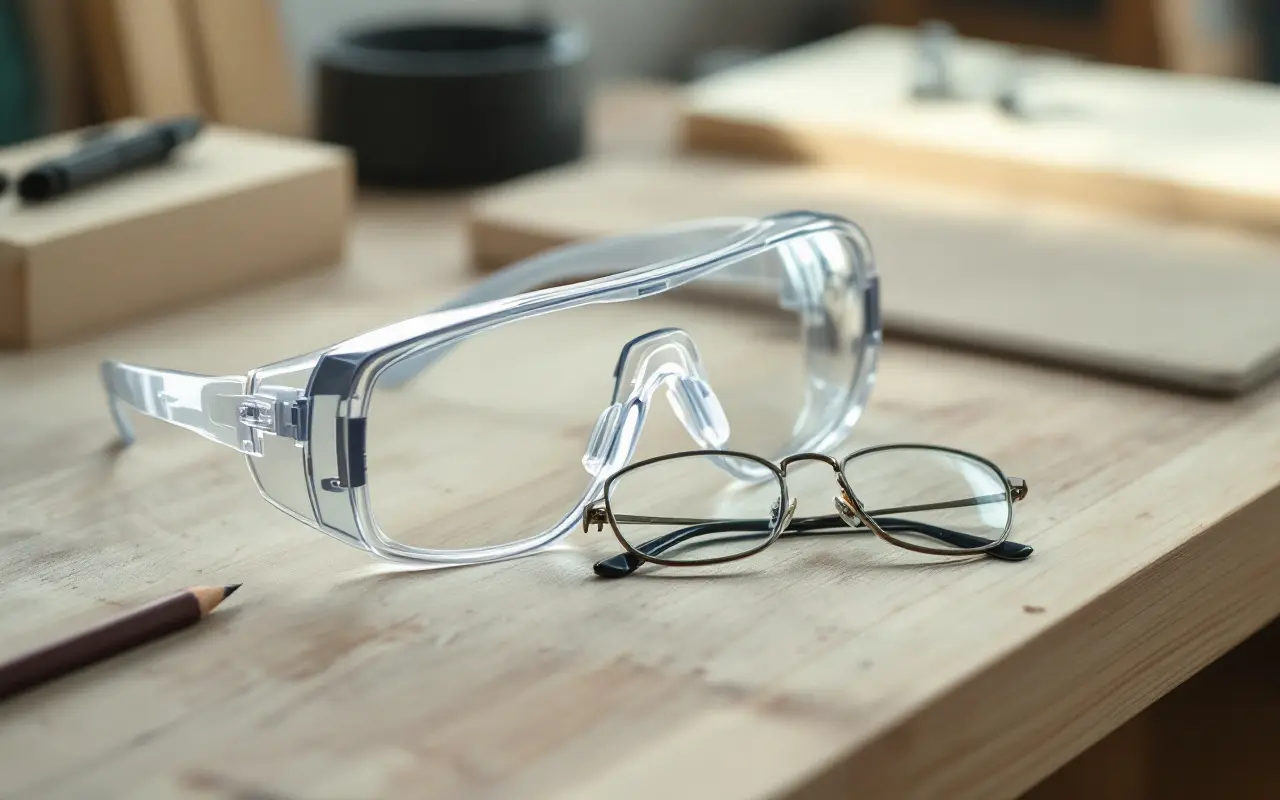
If you wear prescription glasses, your everyday pair is not eye protection. You need one of three things: safety glasses made to fit over glasses, sealed goggles with room for your frame inside, or prescription safety glasses ordered through an optician. Fit-over glasses suit short jobs that throw chips and grit, goggles are better for dust, splashes and chemicals, and prescription safety glasses are the most comfortable for long or frequent work. Whichever you choose, look for a Z87 marking on the frame and the lenses (Z87+ for high impact) and a fit over your own glasses with no gaps or pressure.
When I worked behind the counter of an optical shop, people often asked whether their new glasses were tough enough for the garage. The honest answer was nearly always no, and this guide is about what to wear instead. For the basics (which jobs need eye protection, what the marking means, sizes for children who help), start with safety glasses for yard work and DIY.
Why your everyday glasses are not safety glasses
Everyday glasses are made to see through, not to take a hit. Some lenses are made from tough plastics, but a tough lens in an ordinary frame still isn't safety eyewear. The frame isn't rated, a hard knock can push a lens out of its rim or snap a thin bridge, and the open sides, top and bottom leave plenty of room for grit and splashes to reach the eye. Small or narrow frames leave even more of the eye uncovered.
Safety eyewear in the US is made to the ANSI/ISEA Z87.1 standard. In general terms, "Z87" means the eyewear is impact-rated, and "Z87+" means it carries the high-impact rating, the one to look for near mowers, trimmers, drills and grinders. The mark needs to be on both the frame and the lenses. That holds for all three options below. With prescription safety glasses, ask the optician to show you the marking on the frame and on each lens.
Three ways to protect your eyes when you wear glasses
Safety glasses that fit over glasses
These look like ordinary wraparound safety glasses, only larger, with arms set wide enough to clear your own frame. They go on in seconds, need no prescription, and a spare pair can hang by the door for any glasses wearer who comes to help.
The tradeoffs come from wearing two pairs: two layers of lenses to keep clean and to fog, extra weight on your nose, and very wide or deep frames that may not fit underneath. They suit occasional jobs, such as an afternoon of yard work or hanging shelves.
Goggles that fit over glasses
Goggles seal against your face all the way around, with a cup deep enough for your glasses and a headband instead of arms. That seal makes them the better choice for fine dust or liquid, which drift around the edges of any glasses: sanding drywall, mixing cement, spraying strong cleaners or garden chemicals, drilling into a ceiling. Your own glasses are protected too, which matters on a dusty job, because grit on a coated lens scratches it as soon as you wipe.
Goggles are warmer, fog more readily and press on the face, so save them for the jobs that need a seal. For chemicals, choose goggles whose instructions say they are meant for splash protection.
Prescription safety glasses
These have your prescription built into rated lenses in a rated frame. With one layer of lens they are lighter, show fewer reflections and fog less than two stacked pairs, so they stay comfortable through a long day. For jobs that throw chips, ask for side protection built into the frame or side shields made for it. They take longer to get, need a current prescription, and need new lenses when your prescription changes. If they are for work, ask your employer first, since many workplaces have their own arrangements.
An optician is the simplest route, because the frame has to fit well and the marking has to be on the frame and the lenses. The optician will use your prescription and your pupillary distance, the space between your pupils (how to measure pupillary distance explains it). Before you go, the glasses prescription reader helps you make sense of the numbers on your slip.
If you wear progressive or bifocal lenses, mention the work you do. The reading area sits at the bottom of the lens, which is awkward when you work on a ceiling or lie under a sink, and an optician can talk through designs for overhead or arm's-length work (reading glasses and progressives explains the zones).
How to check that fit-over eyewear suits your frame
A fit-over pair only protects you if it sits close to your face and leaves your own glasses where they belong. I used to suggest people try it with the glasses they actually wear for the job, since reading and distance pairs are often different shapes.
- Measure your frame. Lay a ruler across the front of your glasses at the widest point, usually just outside the hinges. Fit-over eyewear often lists the widest frame it takes, so compare the two numbers before you buy.
- Check the height. In a mirror, your frame should sit fully inside the safety lens, with a little space at the top and bottom.
- Look at the arms. The safety pair's arms run outside your own and should not press them into your head, a quick route to a headache behind the ears.
- Check the nose. The safety pair should rest lightly without pushing your glasses down. If they slide, your view changes, and with progressives you end up looking through the wrong part of the lens.
- Keep the lenses apart. Lens rubbing on lens scratches coatings quickly.
- Move around. Look down, look up, turn your head and shake it gently. Nothing should shift, and from the side you should not see a gap you could fit a fingertip into.
US workplace safety rules make the same point: eyewear worn over glasses should not knock either pair out of position.
For goggles, loosen the headband, settle the cup around your glasses, then tighten the band until the seal touches your face all the way round without pressing the frame into your nose.
Why two pairs fog, and how to stop it
Fogging was a common complaint at the shop counter from people wearing one pair over another. Warm, damp air from your breath and skin gets trapped between the lenses and condenses on whichever surface is cooler. A cold garage in late autumn, a dust mask that pushes your breath upward, or hard work on a warm afternoon all make it worse.
- Treat both layers. Anti-fog safety lenses help, but your own glasses fog too, so clean and treat them as well.
- Let cold eyewear warm up indoors before you start, instead of taking it straight from a cold car or shed.
- Fit any mask or respirator snugly over the bridge of your nose so your breath goes down and out.
- Leave goggle vents open. Taping them shut to keep dust out traps moisture inside.
- Take breaks away from the work. Lifting the eyewear for a quick wipe while someone nearby is still sanding or trimming is how grit gets in.
Safety lenses scratch like your glasses do, so the same sink routine suits both: see how to clean glasses without scratching.
Comfort for long jobs
Two pairs on one nose get heavy over a few hours. Choose the lightest pair that fits, and if a job runs all day or comes up every week, prescription safety glasses are worth asking about. If you wear earmuffs, the cushions sit over two sets of arms, which presses them into your head and can let noise in around the seal, so thin arms help. Wear goggle straps above the ears and only as tight as the seal needs.
Pressure marks on your nose or a headache by midafternoon mean something is pressing too hard. Stop and adjust, rather than pushing the eyewear up onto your forehead and carrying on.
What helps when you wear glasses and need eye protection
Many glasses wearers end up with one pair for quick jobs and a second option for dusty or messy ones. Here is how the choices compare.
| Option | Who it suits |
|---|---|
| Clear safety glasses that fit over prescription glasses | Glasses wearers doing occasional DIY, yard work or cleaning, if their frame is within the listed width |
| Anti-fog safety goggles that fit over glasses | Sanding, sweeping out dust, mixing cement or drilling overhead with your own glasses on |
| Prescription safety glasses ordered through an optician | People who do long or frequent jobs, or need eye protection at work |
| Clear anti-fog safety glasses (ANSI Z87.1) | Days you wear contact lenses instead, and helpers who don't wear glasses |
| Individually wrapped anti-fog lens wipes | Anyone whose two layers of lenses fog in a cold garage or behind a mask |
| Measuring your frame before you buy | People with wide or deep frames choosing a fit-over pair |
| An eye exam if your prescription is out of date | Anyone about to order prescription safety glasses, or squinting at fine work at the bench |
Start with fit. Fit-over safety glasses list the widest frame they take, often around 5.7 inches (about 145 mm), so measure yours first, and look for an ANSI Z87.1 wraparound lens. Goggles made to fit over prescription glasses should also carry ANSI Z87.1, with an adjustable soft headband and indirect vents (covered openings that let air through without a straight path in). Listings don't always say whether a pair carries the high-impact Z87+ marking, so check the frame and lens yourself before using any pair near a mower, trimmer or drill. Anti-fog wipes that also clean the lens are handy here; use them on lenses already free of grit. Contact lenses give no protection, so on those days wear regular safety glasses over them. Avoid pairs with no marking, ordinary safety glasses balanced on your frames, and anything that pinches, because uncomfortable eyewear ends up on top of someone's head.
When to stop and see an eye doctor
Book an eye exam with an optometrist or ophthalmologist if your vision is blurry through clean lenses, if close work gives you headaches or eye strain, or if your prescription is old and you plan to order prescription safety glasses, since an optician will usually need a current one.
Something in the eye is a different matter. Don't rub, and follow the steps in eye emergencies and first aid. In short:
- See an eye doctor today if anything flew into your eye from a power tool, even if it felt like a speck of dust, or if your eye still feels gritty, keeps watering or hurts in bright light after rinsing.
- See an eye doctor today if a blow to the face broke or bent your glasses and you have pain, blurring or double vision.
- Get same-day care for new flashes of light, a sudden shower of floaters or a shadow over part of your vision after a knock.
- Go to emergency care for a chemical splash (after rinsing with plenty of clean water for at least 15 minutes), anything stuck in the eye (leave it in place), or a sudden loss of vision.
Call your local emergency number (such as 911, 999, 112, or 119 in Japan) if you can't get there safely, and don't drive yourself with an injured eye. Finding an eye doctor helps you plan a visit before you need one.
Questions people ask
Can you wear safety glasses over regular glasses?
Yes, if they are made for it. Over-the-glasses styles are sized to clear your frame and sit close to your face. Ordinary safety glasses balanced on top of your glasses tend to slip and leave gaps, and they can push your own pair out of position.
Are prescription glasses considered safety glasses?
Not unless both the frame and the lenses carry a Z87 marking. A tough lens material on its own doesn't make a pair safety eyewear, because the frame and the way it holds the lens matter too.
Can I put safety lenses in my current frame?
Usually not. Prescription safety glasses need a frame rated for the job as well as rated lenses, with the marking on both. Your optician can tell you which frames can be used.
Are over-the-glasses safety glasses OSHA approved?
OSHA doesn't approve individual products. Its eye protection rules point to the ANSI Z87.1 standard and accept either eyewear with your prescription built in or eyewear worn over your glasses that keeps both pairs in position. At work, your employer decides which you use, so ask before you buy.