How to clean glasses without scratching the lenses
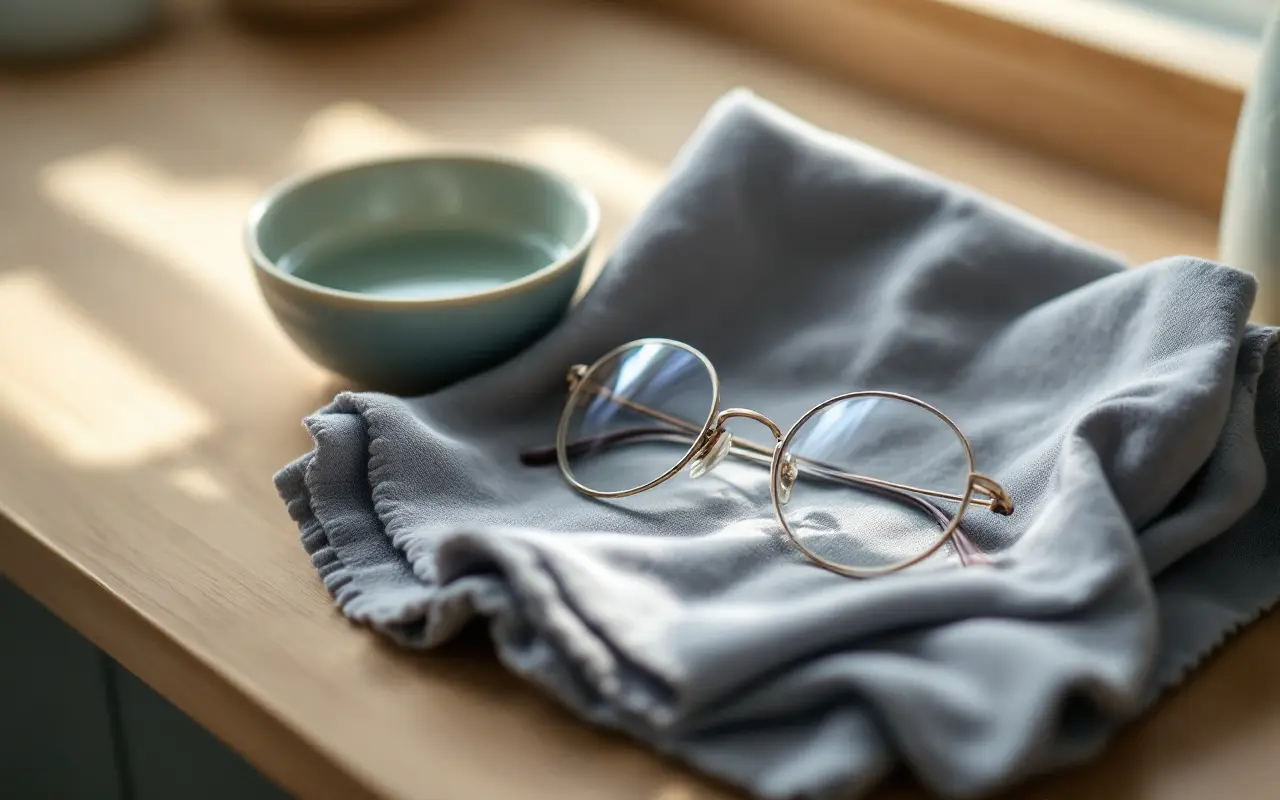
The short answer: rinse your glasses under lukewarm running water before anything touches the lenses, wash them with one small drop of plain dish soap, rinse again, then dry them with a clean microfiber cloth. Most scratches don't come from the cloth. They come from dragging dry dust and grit across the lens, so the first rinse is the step that matters most.
I spent years behind the counter of an optical shop, and the lenses with a fine gray haze of scratches usually belonged to people who cleaned their glasses often, just in the wrong way: a rub with a shirt tail between meetings, a paper napkin at lunch. Below is the routine I used to show customers, the things to keep away from coated lenses, and a couple of small repairs you can safely do at home.
Shop links on this page are affiliate links. As an Amazon Associate I earn from qualifying purchases.
| Item | Who it suits | One note |
|---|---|---|
 A lens cleaning spray and microfiber cloth kit$12.38 Price at Amazon (Oct. 21, 2026, 4:30 p.m. UTC)Look at it on Amazon | Who it suitsEveryday glasses with coated lenses | NoteRinse grit off before you wipe |
 A glasses repair kit with tiny screwdrivers$7.99 Price at Amazon (Oct. 21, 2026, 4:30 p.m. UTC)Look at it on Amazon | Who it suitsA hinge screw that keeps working loose | NoteSmall turns; leave bending to the optician |
 A hard-shell glasses case$4.99 Price at Amazon (Oct. 21, 2026, 4:30 p.m. UTC)Look at it on Amazon | Who it suitsGlasses that travel in a bag or pocket | NoteLenses up, never loose in a bag |
Product prices and availability are accurate as of the date/time indicated and are subject to change.
Chosen from published specifications and reviews; we don’t test products ourselves. The whole eye care tray
Why lenses scratch more easily than you think
Most lenses today are plastic rather than glass. Plastic is lighter and safer if it breaks, but it is softer, so lens makers add a hard coating to the surface. Many lenses also carry an anti-reflective coating, a very thin layer that cuts reflections and glare. Coatings make a lens nicer to look through, but they are only resistant to scratches, not proof against them, and they dislike heat, harsh chemicals and grit.
Ordinary household dust includes tiny hard bits, such as grit carried in on shoes and blown in from outside. Wipe a dry, dusty lens and you push those bits across the coating like very fine sandpaper. One wipe does little harm. Hundreds of wipes leave the haze you only notice when you hold the lens up to a lamp.
Paper is part of the problem too. Tissues, napkins and paper towels are made from wood fibers and are rougher than they feel. Shirt fabric holds onto dust and skin oil, so a quick polish with your sleeve smears and scratches at the same time.
Eye care tray
 Individually wrapped pre-moistened lens wipesA quick clean for glasses away from a sink$15.07 Price at Amazon (Oct. 21, 2026, 4:30 p.m. UTC)Look at it on Amazon
 Individually wrapped anti-fog lens wipesLess fogging when you wear a mask or step in from the cold$12.95 Price at Amazon (Oct. 21, 2026, 4:30 p.m. UTC)Look at it on Amazon
Product prices and availability are accurate as of the date/time indicated and are subject to change.
Shop links on this page are affiliate links. As an Amazon Associate I earn from qualifying purchases. More in the tray
How to clean glasses step by step
You need a sink, a mild dish soap without added lotion and a clean microfiber cloth. It takes about a minute.
- Wash and dry your hands. Hand cream and skin oil on your fingers end up on the lenses.
- Hold the glasses by the bridge and rinse them under a gentle stream of lukewarm tap water. This floats grit away before you rub anything. Avoid hot water.
- Put one small drop of dish soap on a fingertip. Skip soaps with moisturizers or hand-softening additives, which leave a film that smears.
- Rub both sides of each lens gently with your fingertips, then the nose pads, the bridge and the ends of the arms (the temples) where they touch your skin.
- Rinse thoroughly until no soap is left. Leftover soap dries into streaks.
- Shake the glasses gently to flick off most of the water.
- Dry the lenses with a clean microfiber cloth and light pressure. If spots remain, don't scrub harder: rinse and dry again.
A wash like this every day or two keeps most lenses clear.
Nose pads and hinges
The gunk that collects where nose pads meet the frame, and around the hinges, is a mix of skin oil, makeup and sunscreen. A soft, clean toothbrush kept only for your glasses, dipped in soapy water, lifts it out. Use it on the pads, pad arms and hinges, never on the lenses, then rinse well. Clean pads also grip your nose better.
Cleaning away from a sink
At work or on the road, a lens cleaning spray made for eyeglasses is the next best thing. Spray both sides generously so the cloth glides over a wet surface instead of dry dust, then wipe gently with a clean microfiber cloth. Individually wrapped lens wipes do a similar job. If the lenses look gritty, though, wait until you can rinse them, because no cloth can lift grit without dragging it a little.
What never to use on coated lenses
Habits I saw damage lenses again and again:
- Shirt tails, sleeves, scarves and ties
- Paper towels, tissues, napkins and toilet paper
- Saliva, which smears oil around and isn't clean
- Household glass or window cleaner, many of which contain ammonia, and also bleach or vinegar, which can strip or cloud lens coatings
- Acetone (nail polish remover), which damages plastic lenses and many frames
- Toothpaste or baking soda, popular "scratch removal" tricks that are abrasive and only add scratches
- The dishwasher, for the heat and the strong detergent
Heat is the hidden enemy
Heat damages lenses quietly. Hot water, a hair dryer, a sauna and the dashboard of a parked car on a sunny day can all harm a coated lens. The lens and its coating expand at different rates, and the coating can craze: a fine web of cracks that looks like a smudge that won't wipe off. Plastic frames can warp in the same conditions, and the summer dashboard was one of the most common ways I saw a good pair ruined.
Looking after the cloth and the case
A microfiber cloth only protects your lenses while it is clean. Once it is full of skin oil and grit, it spreads both. Wash it whenever it looks or feels dirty: by hand in warm water with a little dish soap, or in the laundry with your other washing. Leave out fabric softener and dryer sheets, which coat the fibers and leave smears on the lens, and let the cloth air dry. Keep it in your case rather than loose in a bag, and replace it when it no longer comes clean.
When your glasses aren't on your face, a hard case is the safest place for them. A soft pouch keeps off dust but does nothing if the bag gets sat on. If you put your glasses down for a minute, fold them and rest them on the folded arms with the lenses facing up, never lens-down on a table. Pushing them up onto your head stretches the frame.
Many optical shops also have an ultrasonic cleaner, a small tank that uses vibration in a cleaning liquid to shake dirt out of hinges, pad arms and the groove where the lens meets the frame. Shops often run glasses through it while you wait, for little or no charge, and the staff know which frames and coatings shouldn't go in. Ask your optician before buying a home unit, because it isn't right for every pair.
Small repairs: a loose hinge screw
A loose hinge screw lets the temples flop open and the frame slide down your nose. Tightening one is a fair job for home if you go slowly.
- Work over a towel on a table. These screws are tiny, and they bounce.
- Choose a screwdriver tip that fills the slot of the screw. A tip that is too small slips and scratches the frame.
- Open the temple and hold it steady so the hinge holes line up.
- Turn the screw clockwise until it feels snug, then stop. Overtightening can strip the thread, crack a plastic frame or make the hinge stiff.
- A missing screw needs a replacement of the same size. A kit with assorted screws may have one; if not, an optician will.
Some jobs are better left to the optician: frames that are bent or twisted, a lens that has popped out or rattles in its rim, rimless and semi-rimless frames where small screws or a thin cord hold the lens in place (overtightening can crack a drilled lens), adjusting nose pad arms, and anything that needs heat. Progressive lenses are especially sensitive, because a small shift moves the reading zone away from your eyes. There's more on that in the column on reading glasses and progressives.
What helps keep lenses clean and scratch-free
The sink routine does most of the work. A few simple items make it easier to keep up the habit away from home.
| Option | Who it suits |
|---|---|
| A rinse, a drop of dish soap and a clean cloth at the sink | Everyone, as the everyday routine at home |
| A lens cleaning spray and microfiber cloth kitAmazon | A desk drawer, the car, and anyone with anti-reflective lenses who often cleans away from a sink |
| Individually wrapped anti-fog lens wipesAmazon | Mask wearers, cold-weather commuters and anyone who needs a quick clean on the go |
| A hard-shell glasses caseAmazon | Anyone who carries glasses in a bag, a coat pocket or a glove box |
| A glasses repair kit with tiny screwdriversAmazon | People whose hinges loosen now and then, or who want spare nose pads at home |
| A cleaning and adjustment visit at an optical shop | Glasses with built-up grime, a loose fit or a lens that seems to have shifted |
For a spray, choose one made for eyeglass lenses and described as suitable for anti-reflective coatings, and avoid screen or window cleaners. Wipes are for a quick clean of lenses that are already free of grit; they don't replace a proper rinse. A hard case needs a soft lining and room for your frame. A repair kit is for tightening screws and swapping a nose pad, not for straightening a bent frame.
Scratched lenses, and blur that isn't dirt
A scratch on a coated lens can't be polished out. Products that promise to remove scratches tend to fill them for a while or wear away the coating, and the lens ends up worse. Once a scratch sits in your line of sight, or the coating peels or crazes, the fix is a new lens, often fitted into your current frame. When you get the new prescription, the glasses prescription reader explains what each number on the slip means.
Sometimes clean glasses still look foggy, and the problem isn't on the lens at all. Hold the glasses up to a light. If the lenses look clear but your view through them is still hazy, your prescription may have changed, or something inside the eye may have, such as a cataract, a clouding of the eye's natural lens that often shows up as haze and glare. That calls for an eye exam, not a better cloth.
When to see an eye doctor
Book an eye exam with an optometrist or ophthalmologist if your vision is blurry even with freshly cleaned glasses, if you get frequent headaches or eye strain, or if your glasses never feel right after a repair. (An optometrist examines eyes and measures prescriptions; an ophthalmologist is a medical doctor who treats eye disease; an optician fits glasses.) The guide to finding an eye doctor and planning a visit explains how to book.
See an eye doctor the same day if you notice new flashes of light, a sudden shower of floaters, or a shadow or curtain across part of your vision. These can be signs of a retinal tear or detachment.
Go to an emergency department, or call your local emergency number (such as 911, 999, 112, or 119 in Japan), for:
- Sudden loss of vision in one eye, even if it comes back within minutes, which can be a warning sign of stroke
- Severe eye pain with blurred vision, especially with haloes around lights, headache or nausea
- A broken lens with a fragment in or near the eye: don't rub the eye or try to remove anything yourself
If a cleaning product such as window cleaner splashes into your eye, don't rub it. Rinse at once with plenty of clean water for at least 15 minutes, then get urgent care. Eye emergencies and first aid covers what to do while you get help.
Questions people ask
Is it safe to clean glasses with dish soap?
Yes, as long as it is a plain dish soap without added lotion and you rinse it off completely. One small drop is enough for a whole pair. It cuts through skin oil gently and is what many opticians suggest for everyday cleaning.
How often should I wash my microfiber cloth?
Whenever it looks or feels dirty. If you use it every day, once a week is a reasonable habit. Skip the fabric softener and let it air dry.
Why do my lenses still look smeared after cleaning?
The usual causes are soap left on the lens, a soap with lotion in it, or a cloth that is dirty or was washed with fabric softener. Rinse longer and try a freshly washed cloth. If a cloudy patch still won't shift, the coating itself may be damaged, so ask an optician to look at it.
Can scratches be removed from glasses?
Not from a coated lens. Fine scratches can't be buffed out without damaging the coating, and deeper ones are permanent. If scratches bother you or sit where you look through the lens, ask an optician about replacement lenses.